Generating a voiceover is already fast. The second pass is harder.
“This feels mechanical.” “This section rushes.” “The final sentence does not land.” These are useful reactions, but they do not travel cleanly into the next TTS run. Someone has to reopen the timeline, find the sentence, and decide whether the script, pause, or cue duration should change. Voice cloning gives a project a sound. Delivery still needs someone to handle rhythm.
That is where Voxr sits. It does not generate speech. It reads a post-generation SRT and reviews subtitle coverage, adjacent gaps, Chinese CPM, English WPM, and rate shifts between neighboring cues. When the user is authorized, matching audio can also stay in the browser for replay, PCM waveform, sample peak, and RMS inspection.
The first render is rarely the hard part
AI-video narration often takes several passes. The first pass confirms a voice. The second exposes rhythm: a dense definition, a pause that breaks the picture, or a short run of cues whose pace shifts abruptly.
“Generate again” is a poor response to all of these. Each new render introduces variables: pauses move, sentence length changes, and the voice can drift. A more useful move is to preserve the current version, mark a replayable timecode, and choose one next action.
Voxr puts that action first. It does not declare a voiceover pass or fail. It says: review these moments first. Each item carries a timecode, a visible timeline signal, and a reversible action: split at a clause, extend a cue, or check whether a long gap actually serves the picture.
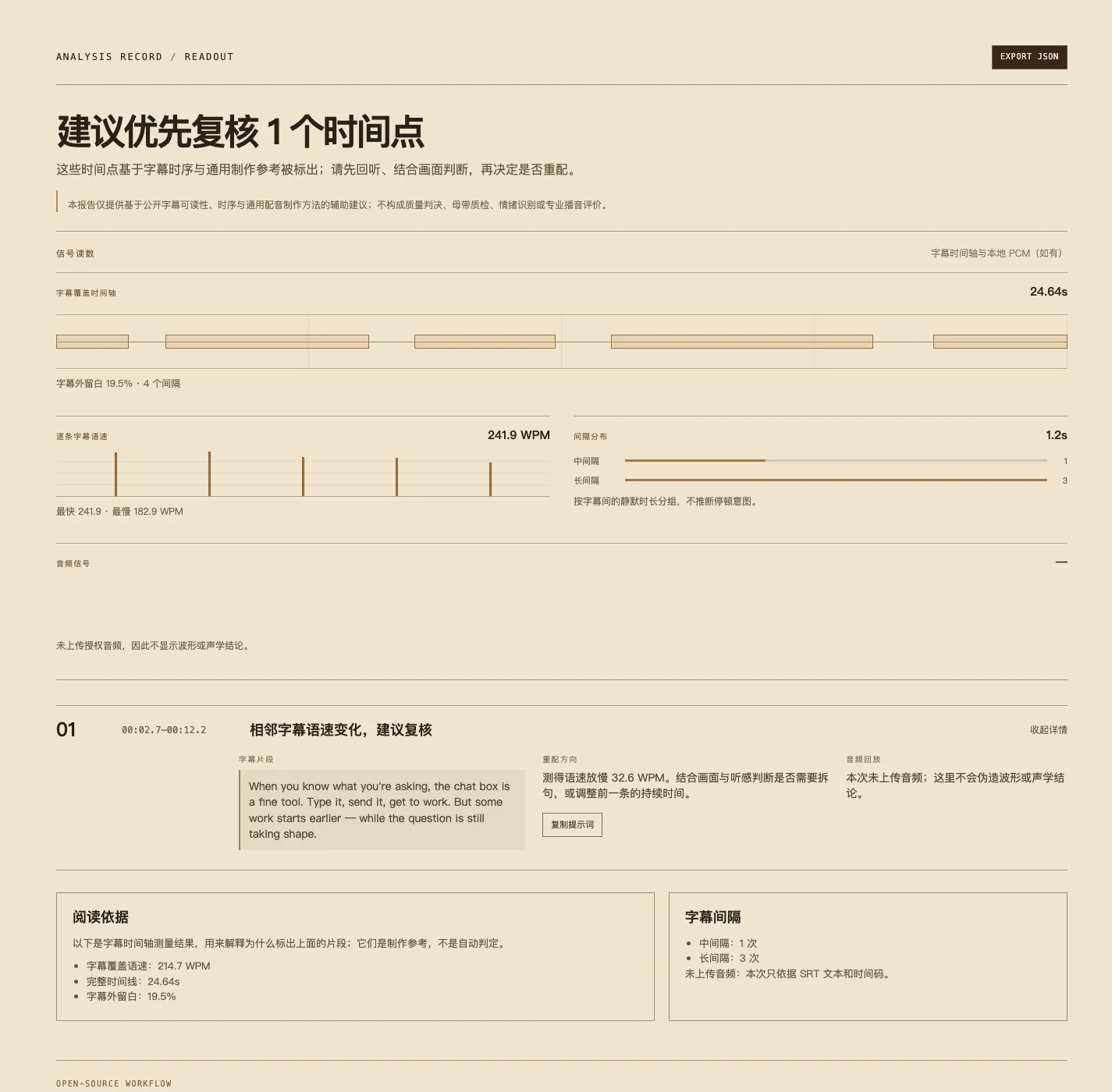
This is an actual Voxr run. The page imported the repository's English SRT fixture with no audio attached and used the Chinese interface. The report shows timeline coverage, cue-level WPM, gap distribution, and the specific clip selected for review.
SRT is the lightest useful handoff after generation
Voice tools can output audio. In a production workflow, SRT is often easier to inspect, edit, and pass to another person. It retains three useful facts: what was said, when it starts, and when it ends.
Those facts cannot establish emotion or actual voiced duration. They can reveal where listening should begin. Voxr treats an SRT as a timeline record. It does not call time outside subtitle coverage silence, and it does not infer voice identity, emotion, or professional performance from a waveform.
That boundary matters. A tool should point to a review entrance. Listening judgment still belongs to a person and the actual picture.
Give the next pass something concrete
The web tool is for a quick review of one voiceover. For batch work, Voxr can export `voice-iteration-package.json`: delivery purpose, input boundary, parser warnings, timeline readings, priority review items, and general regeneration prompts.
It does not call a TTS service or operate a voice-cloning tool. The package simply removes one round of guessing: which clip, why it needs review, and what to try first.
The open-source repository also includes a Voxr Rhythm Review Skill for carrying those evidence boundaries into an agent workflow. It distinguishes SRT timing, measured local PCM, and subjective listener feedback. “Mechanical” remains a listening hypothesis, not an automatic diagnosis.
Make the next pass legible first
Synthetic voiceover work does not end when a render appears. Time disappears when every revision starts by explaining what felt wrong again.
Voxr currently makes one small move: attach that reaction to a timecode, replayable evidence, and a reversible change. That is already useful in an AI-video workflow that needs frequent voiceover revisions.