The gist
Moonshot's Kimi K3 (the largest open-source model at 2.8 trillion parameters) flooded X within 24 hours of launch. macOS 27 in a browser with 783K views, a 3D open-world game, Simon Willison's signature pelican test. But viral demos show the model's ceiling, and you deal with the floor. I spent a day filtering the marketing noise and found three real signals: Agent Swarm is a genuine product form, vision-in-the-loop is a real capability leap, and there's a huge gap between "demo works" and "daily tool works". Also worth remembering: a 4-hour agent run costs roughly $20-50, and the weights don't actually release until July 27.
24 hours of virality
For the past 24 hours, my X timeline has been flooded with Kimi K3.
A macOS 27 web version with 783K views. A 3D open-world game you can spin up in hours. Simon Willison's signature bicycling pelican, redrawn by K3 in 3,417 tokens. Moonshot's largest open-source model at 2.8 trillion parameters. Everyone had something to say.
But these viral demos won't tell you one thing: they show the ceiling, not the floor. And what you deal with every day is the floor.
I spent a full day filtering noise: official blog, community demos, third-party reviews, Hacker News threads. Strip away the marketing, and three real signals emerge.
The three viral cases, reviewed one by one
Case 1: macOS 27 web version
What you saw: a fully functional macOS 27 running in a browser. Liquid Glass UI, draggable windows, working Voice Memo, cross-session state retention. Max Weinbach, a tech creator with 800K followers, generated it with a single prompt: "Build a macOS 27 system in the browser, including all native apps, as close to Liquid Glass as possible."
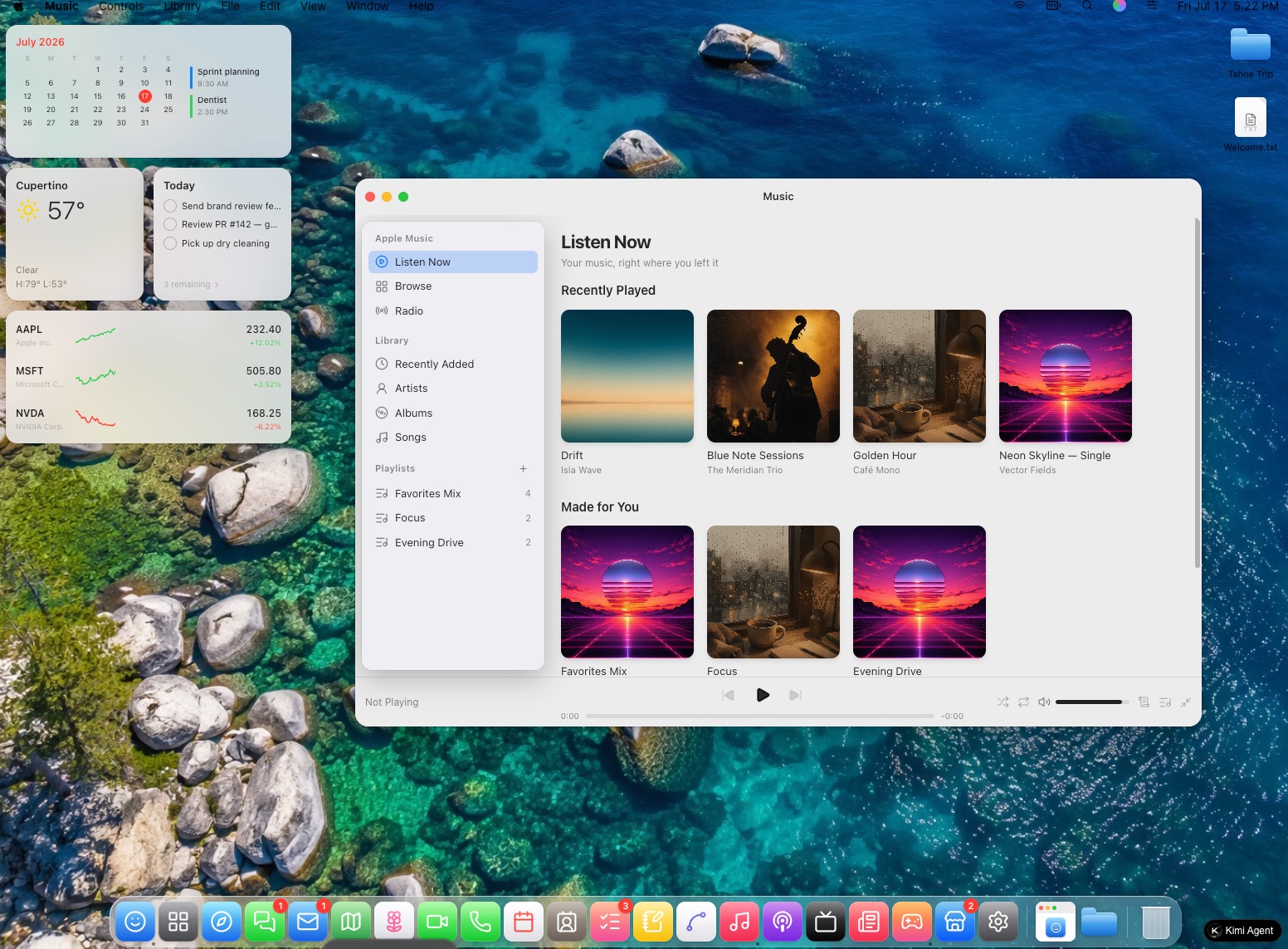
What you didn't see: it ran for 4 hours. Not "one prompt, instant magic." It was 4 hours of Agent Swarm orchestration. It burned real money. At K3 pricing ($3/M input, $15/M output tokens), a single 4-hour agent run costs an estimated $20-50. The prompt was expert-level. "As close to Liquid Glass as possible" is the kind of prompt an 800K-follower tech creator writes. Your casual "make a macOS clone" won't produce this. Plus survivorship bias. You saw the one that succeeded. You didn't see the ones that crashed, timed out, or half-finished.
My judgment: real capability, but "anyone can do this" is an illusion. This is the ceiling, not the mean.
Case 2: 3D open-world game
What you saw: a playable 3D open-world game running in a browser. Forests, snow mountains, dynamic weather, day-night cycles, a cowboy on horseback. Fully procedurally generated with Three.js WebGPU + GPU compute. Moonshot's official showcase, the flagship demo of the launch blog. Try it: horseback-open-world.ok.kimi.link
What you didn't see: vision-in-the-loop is the real story. K3 doesn't just write code. It takes screenshots of its own work, evaluates them, then iterates. The model is both designer and QA. That loop is why the demo works. Procedural generation and game design are two different things. The world looks stunning, but there are no quests, no NPCs, no win conditions. It's a tech demo, not a game.
The official blog actually has 9 of these demos. I scraped the HTML source and found the file paths: game-cases/01-open-world.png through 09-gargantua.jpg. GBA emulator, wuxia RPG, FPS arena, cyberpunk swing, black hole. Moonshot made 9, only pushed 1. The other 8 exist but weren't promoted.
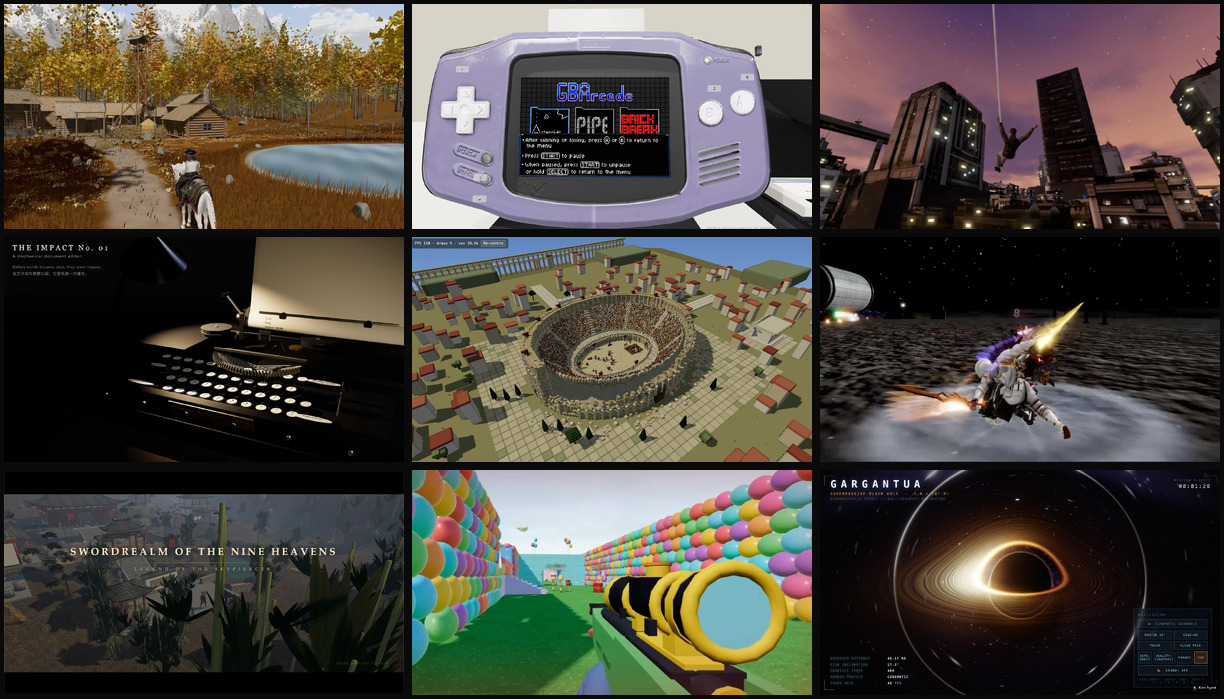
My judgment: technically impressive. vision-in-the-loop is a real innovation. But "playable game" is a stretch. It's a beautiful 3D scene with WASD controls.
Case 3: Simon Willison's pelican
What you saw: Simon Willison, the most authoritative independent voice in LLM evaluation, ran his signature test: "Generate an SVG of a pelican riding a bicycle." K3 produced a complete colorful SVG scene: white pelican, orange beak, red scarf, red road bike, blue sky, sun, clouds, birds, flowers, dashed road.

What you didn't see: real data. About 95 input tokens, over 16,000 output tokens, most of which was reasoning. Total cost: roughly a quarter. One pelican. Twenty-five cents. This test is a meme, not a benchmark. Simon's pelican test is useful because it's comparable across models, but it only tests one thing: SVG generation. It tells you nothing about how K3 handles document summarization, coding, or data analysis. Simon himself was measured. His verdict: "a very solid model." Not "revolutionary." Not "a GPT killer." Solid.
My judgment: a useful data point from a credible source, but one test does not equal a model evaluation. And twenty-five cents a pelican adds up.
What the official blog won't tell you
I read Moonshot's entire K3 launch blog. I also read the HTML source.
1. Some official demos timed out
Two cases in the official blog, "fusion industry research" and "GWTC-5 gravitational wave analysis," are marked in the page source as "Presentation unavailable / The presentation timed out."
Moonshot's own demos crashed. They left the timeout markers in the HTML. Credit where due: they didn't hide them. But they didn't mention them in the body text either.
2. The community reported real problems
From aibenchy's test (@XCSme): quite slow. The SVG hamster ping-pong animation took about 9 minutes to generate. Tool calling schema compatibility issues. K3 rejects anyOf-style tool schema writing, which is a standard JSON Schema pattern that other models handle fine.
From the X community: agent runs easily trigger rate limits. Max thinking effort is on by default, and costs accumulate fast.
3. Pricing is a real consideration
K3 is priced at $3/M input tokens, $15/M output tokens. For comparison:
- DeepSeek V4: $0.435/$0.87, clearly cheaper
- Kimi K2.6: $0.95/$4.00, cheaper and already strong
- Claude Fable 5, GPT-5.6 Sol: premium positioning, higher pricing, different tier
K3 sits at the high end of open-source model pricing. Significantly more expensive than its own K2.6, several times more than DeepSeek V4. The question is whether that premium is worth it for your use case.
4. The weights aren't actually released yet
This is the big one. Despite "open-source 2.8 trillion parameter model" being the headline, the model weights don't actually release until July 27, 2026, ten days after the launch announcement.
Right now K3 is only available via API. "Open source" is a promise, not a present reality. If you plan to self-host, wait another 10 days. If you're evaluating it as an "open-source model," you're evaluating marketing.
Three real signals
After filtering out marketing, survivorship bias, and expert-level prompts, here's what I think actually matters about K3:
Signal 1: Agent Swarm is the real product form, the model is just the engine
The macOS 27 demo was fundamentally K3 orchestrating multiple sub-agents for 4 hours: planning, coding, testing, iterating, self-correcting. The model is the engine, Agent Swarm is the car.
This matters because it changes the value proposition. You're not buying a smarter chatbot. You're buying a system that can run long-horizon tasks continuously. Whether a single run at $20-50 is worth it is a separate question, but the capability itself is real.
Signal 2: vision-in-the-loop is a real capability leap
Most LLMs can write code. Few can look at their output and iterate. K3 can screenshot its own work, evaluate the visual result, and adjust the code. This is a meaningful step toward self-verification.
The Open World demo works because of this loop. The model writes Three.js code, renders it, notices the lighting is wrong, fixes it. Without vision-in-the-loop, you'd get a crashed 3D scene with no way to auto-correct.
Signal 3: The gap between "demo" and "daily tool" is the real problem
Every K3 viral case I saw falls into one of two categories:
- One-time spectacle (macOS 27, Open World, SVG pelican): impressive, but not something you use daily
- Long-horizon agent tasks (ASIC 42 report, chip design): genuinely useful, but burns real money and real time
What's missing from the discussion: how does K3 perform on boring things? Email drafts, document summaries, meeting notes, code review. 95% of AI use cases never make it to X.
The test you can run yourself
Don't trust my analysis. Don't trust the viral demos. Don't trust Moonshot's blog. Run your own test.
Use your own tasks, not test questions. Open platform.kimi.ai/playground. Pick three things you actually need to do today: that difficult email you've been putting off, that report you haven't finished reading, that Excel formula problem. Ask K3. Then ask GPT, Claude, or whatever you currently use. Compare the answers yourself.
Test long context with your own documents. Upload a long document you've actually read. Ask detail questions. Then chat for 30 rounds. On round 30, ask about something from the beginning. Does it remember? K3 claims 1M token context. Test it with your real workflow, not their demo.
Calculate costs based on your own usage. Estimate how many tokens you'd actually use in a week. Multiply by K3 pricing. Compare to what you pay now. If K3 saves you 2 hours a week but costs $20 more than your current tool, is that trade worth it? Only you can answer.
K3 is an important model. Agent Swarm capability is real. vision-in-the-loop iteration is genuine progress.
But the viral narrative around K3, "one prompt, instant magic," is marketing, not reality. The reality: 4-hour agent runs, $20-50 in costs. Expert-level prompts producing mediocre results in untrained hands. Stunning demos that don't translate to daily productivity gains. A premium-priced model whose "open-source" weights don't exist yet.
My advice: wait a week. Let the community run it through real scenarios. Let the weights actually release on July 27. Then evaluate it with your own tasks, not their demos.
The best model is the one that makes your work easier.
Not the one that makes the most stunning demo.
Verified links
Interactive demos (verified accessible):
- macOS 27: macos27.kimi.page
- 3D open world: horseback-open-world.ok.kimi.link
- ASIC 42 report: asic42.ok.kimi.link
- Official Playground: platform.kimi.ai/playground
Key sources:
- Moonshot official blog: kimi.com/blog/kimi-k3
- Simon Willison's analysis: simonwillison.net
- Max Weinbach's macOS 27 tweet: x.com/mweinbach
- Hacker News discussion: news.ycombinator.com