The gist
Most meetings don't exist to make decisions. They exist to make decisions look good. AI meeting tools make this worse: the more perfect the notes, the more invisible the truth. I built an open-source skill (biz-retro-analyzer) that does the opposite of prettifying notes: it audits whether a judgment actually has evidence, and who is really driving the direction. To test it, I used Werewolf as a stress test, forcing it to maintain evidence discipline amid public claims, hidden roles, and contradictory testimony.
That smooth big meeting you sat through
The notes came out. Complete, professional. Every discussion has a conclusion. Every item has an owner. Every exchange has a tidy summary.
You skimmed it, thought it looked fine, marked it read.
Three days later someone asks you: in that meeting last week, how did we actually land on Option B?
You think for a while. You can't say. The notes say "after thorough discussion, the team unanimously agreed on Option B." But you can't recall: whose argument changed the room? Which data moved whom? What objections were withdrawn?
Because none of that actually happened in that meeting.
The real decision was never in that room
After years of business negotiations and project reviews, I reached an uncomfortable conclusion:
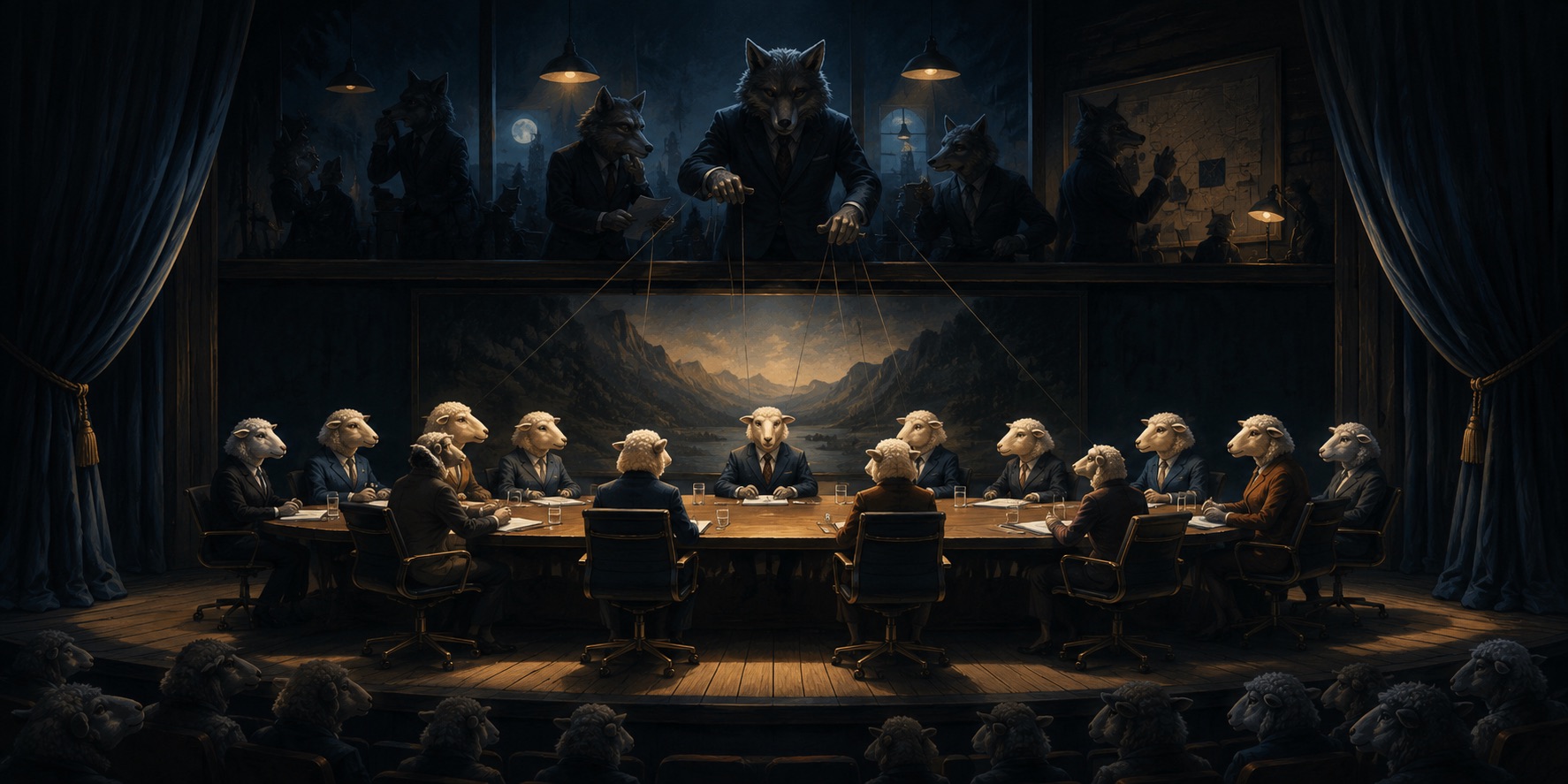
A significant portion of meetings are performances.
The real decision was made earlier, in a smaller room, by fewer people. The bigger meeting exists to make that decision visible, transmitted, and process-approved.
In those meetings, most statements are postures. Most alignment is ritual. Most discussion is consensus theater. You think you're participating in a decision. You're actually attending the decision's press conference.
Then AI made the performance more convincing
AI meeting tools thrive in this environment. They transcribe, summarize, extract action items, generate fluent and complete professional documents. Every conclusion looks well-founded, every step looks clear and unambiguous.
But they are too good at smoothing things out.
So smooth that you eventually ask:
If everything was already aligned, every step was clear, and every conclusion was obvious, why did this meeting need to happen at all?
When AI "analyzes who influenced whom," it's actually manufacturing a more sophisticated script for a performance. It rewrites postures as influence, rituals as consensus, and blanks as conclusions.
So I built something that does the opposite
Biz Retro Analyzer is an open-source skill that doesn't make prettier meeting notes. It does the reverse: it audits judgment.
The logic is three layers:
- Notes make information shorter
- Retros make judgment clearer
- Audits make judgment answer to evidence
The first thing it does isn't give answers. It classifies: is this a fact, someone's claim, or a model inference? These three things get mashed into one blob in regular notes. In an audit, they must stay separate.
Then it asks one question: could this conclusion be wrong?
It also has an honest boundary: it can flag meetings not worth deep retrospection because they were performative. Retrospecting a performance doesn't reveal truth. It creates a better-looking illusion.
How do you know it actually works? I tested it on Werewolf
The biggest risk of an audit tool is that it pretends to be certain in complex dialogue. To test this, I needed a scenario where public claims, hidden roles, and contradictory testimony all exist simultaneously.
Werewolf is exactly that scenario, compressed.
I designed a synthetic case: 12 players, 4 wolves, no daytime role reveal. Everyone speaks publicly, but only some are telling the truth. A fake seer (P8) gives a "verified good" badge to another wolf (P11), P11 transfers that authority to P2, and P2 uses it to eliminate an innocent P12.
The full influence chain:
P8 claims seer → gives P11 verified-good badge → transfers authority to P11 → P11 transfers to P2 → P2 uses authority to eliminate P12
This was the most strategically relevant structure in the case. The tool identified it correctly in the blind run.
But it also made an instructive mistake
Player P3 verbally supported eliminating P2 on Day 3, but actually voted for P12 twice, and his vote was decisive.
The tool flagged P3 as a suspicious wolf.
The answer key revealed P3 was a villager who made a decisive mistake.
This error exposed a core issue:
Suspicious action is a diagnostic signal, but it should not automatically become evidence of bad-faith motive.
This maps directly onto real meetings: someone changes their story mid-meeting, votes the opposite way, goes suddenly silent. These behaviors are worth noting, but they don't mean they're scheming. They might have been persuaded. They might not have understood. They might have received information from outside the room.
Strip the evidence tags, and it starts confidently making things up
I also ran an ablation test. When I removed all evidence-grading tags from the tool, the AI was forced to give a confident answer at a fifty-fifty judgment point.
It got the answer wrong. With confidence.
That is the real danger of AI in complex dialogue:
It pretends to be certain where it should hesitate.
So the core goal of this tool is not to make AI sound smarter. It is to make AI less overconfident.
The project is open source. The GitHub repo includes the protocol, test records, failure modes, ablation notes, and the honest boundary statement. github.com/dlxeva/biz-retro-analyzer
After a meeting ends, I want a tool that helps me ask one question:
What did we actually decide here, and on what evidence?