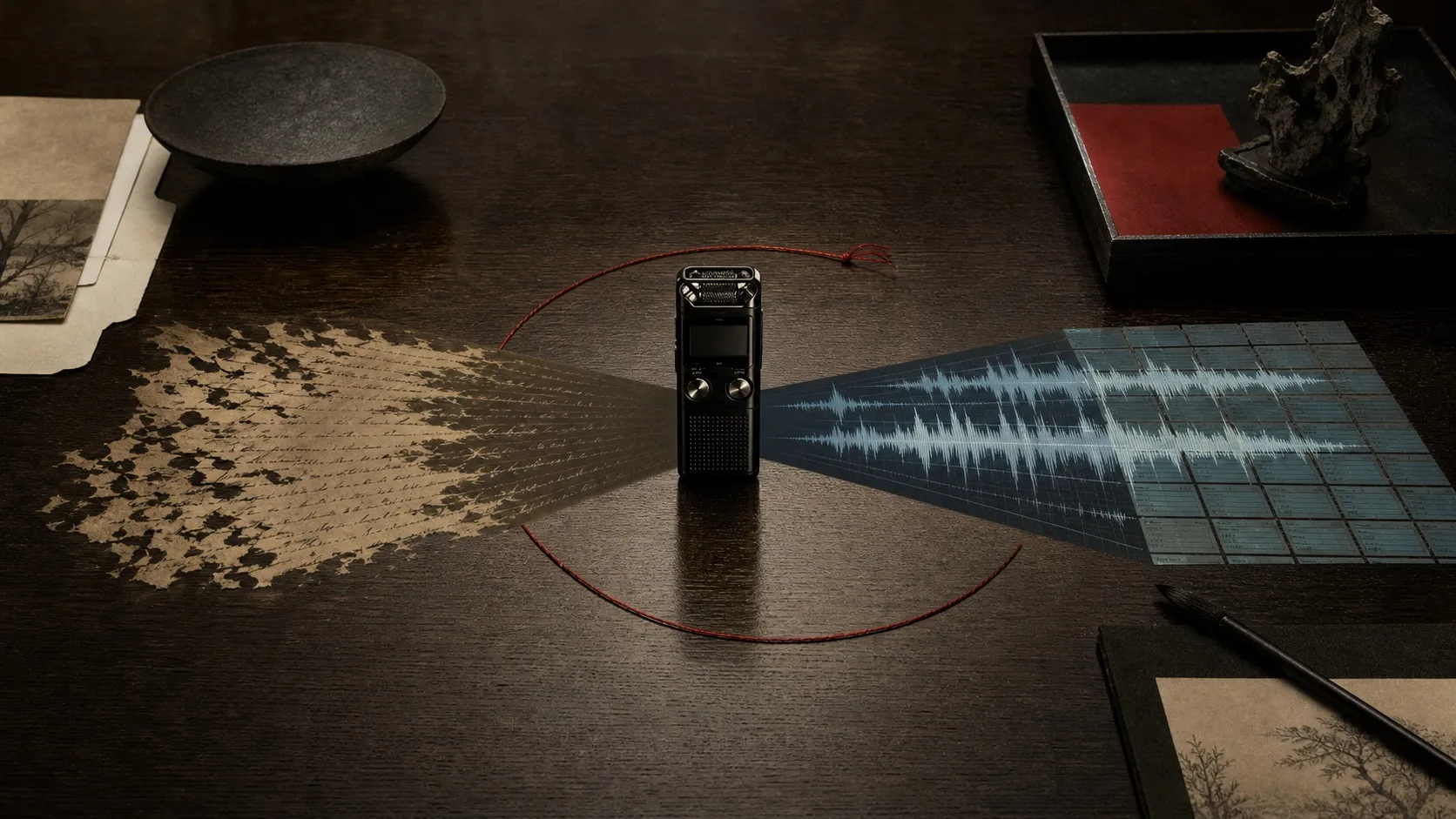
I do not oppose recording devices. In a public meeting, interview, class, or collaborative project, a disclosed record can help a group keep context, revisit decisions, and include people who were absent. It can act as an extra memory for everyone in the room.
What I find hard to accept is a different arrangement: continuous recording carried into a private conversation, with one person alone deciding when it starts, when it stops, who can search it, how long it stays, and where it goes.
The decisive question is not whether a device exists. It is whether recording is shared, clearly disclosed, rejectable, and subject to access and withdrawal rights for the people whose lives enter it.
Shared context and one-sided capture
A meeting record can serve its participants when its purpose is clear, its scope is announced, its notes can be checked, and its source material has a defined retention period. That is a group building common context.
AI pendants, glasses, and voice assistants promise a “second brain.” Yet the memories they collect are rarely produced by one person alone. A dinner includes someone else’s story. A meeting includes someone else’s judgment. An argument includes someone else’s emotion and boundary.
Once those moments are continuously captured, transcribed, searched, summarized, and analyzed, they gain new powers: durable storage, replication, recombination, and inference. The wearer gains efficiency and recall. Bystanders supply voice, ideas, social clues, and private information.
Research describes this position as bystander privacy or non-user privacy. People around a sensing device may have no account, settings page, or deletion control, yet still fall inside its collection range.
An indicator light is not consent
A recording light has value because it makes collection easier to notice. It does not answer the rest of the questions: What is being collected? Does it remain local or go to a cloud service? How long will it live? Who gets access? Can it train a system? Can participants ask for deletion?
These questions are already hard among friends. They are harder in a workplace. When a manager brings a device into a meeting, how free is an employee’s agreement? When a friend turns on a recorder at dinner, how many people swallow a refusal to avoid becoming the awkward one?
Schrödinger’s conversation
When I do not know that recording exists, I may say what I actually mean in that moment. When I know a device is collecting the room, one sentence splits in two: the version I want to say, and the version I am willing to hand to future transcription, search, replay, and analysis.
Call this Schrödinger’s conversation. Both versions exist until I decide which one is safe enough to speak.
Recording does more than preserve a conversation that has already happened. It enters the conversation early, like an invisible third participant. It encourages people to write lines for a future without the original context. The captured record therefore has no automatic claim to be the fullest or truest account of what people meant.
Research on digital surveillance calls this kind of self-restraint a chilling effect. A system can gather more content while people offer less of their real thinking.
“Pay me” is a useful question
“If you record me, pay me.” This is not a price list. It is a way to make an invisible exchange visible.
The moment payment is involved, people ask useful questions: What is this recording worth? What will you do with it? How long will you keep it? Who receives it? Can I withdraw it? Free collection often hides an asymmetry: one person accumulates a durable asset while another bears exposure, misreading, leakage, and reuse outside the original context.
Compensation cannot settle every issue. Intimate relationships, medical conversations, and unequal work relationships should not be reduced to a rate card. Compensation concerns value distribution. Consent protects a person’s boundary.
A right to refuse at the level of the room
Private conversations, clinics, creative reviews, and sensitive meetings need clear space-level rules. Continuous collection should pause by default. Everyone should know whether recording is active, be able to refuse it on the spot, agree on what is retained, and later inspect, withdraw, or delete it.
The point is not an arms race between devices. The point is for social rules, product defaults, and a person’s right to leave the system to work together.
Public, explicit, participant-controlled recording can be a good collective memory. Private, one-sided continuous capture turns a relationship into a data pipe controlled by one party. Your second brain can exist. It should not grow by unilaterally taking possession of other people’s lives.