Specimen Note
OffsideFence™ is a fictional offside-correction collar built on a real, open-source soccer vision pipeline (Roboflow sports: player detection, pitch keypoints, homography, tactical radar). It will never ship, never scale, never get a storefront. The whole project exists to test one question: if you build a fake product with the engineering rigor of a real one, can you make the people who should know better pause and wonder "wait, is this real?" This is the thinking behind it, from the original spark to the three-layer structure, the product persona, and the one metric that defines success.
It started with an unrelated technical discovery
June 2026, during the World Cup. I was reading through an open-source project.
Roboflow had released a complete sports vision pipeline. It tracks 22 players in real time, detects geometric features on the pitch (corner arcs, center circle, penalty box lines), uses homography estimation to map the 2D broadcast pixels onto a top-down view of the real pitch, and outputs a tactical radar. The whole stack is public. Anyone can run it.
Reading through it, one thing kept nagging at me.
VAR uses this exact technology to tell the referee "he was offside." Nobody uses it to tell the striker "you are offside right now." The technology can already pinpoint the offside line down to the centimeter, but all that precision flows only into punishment, never into prevention. Detection and correction are two different things.
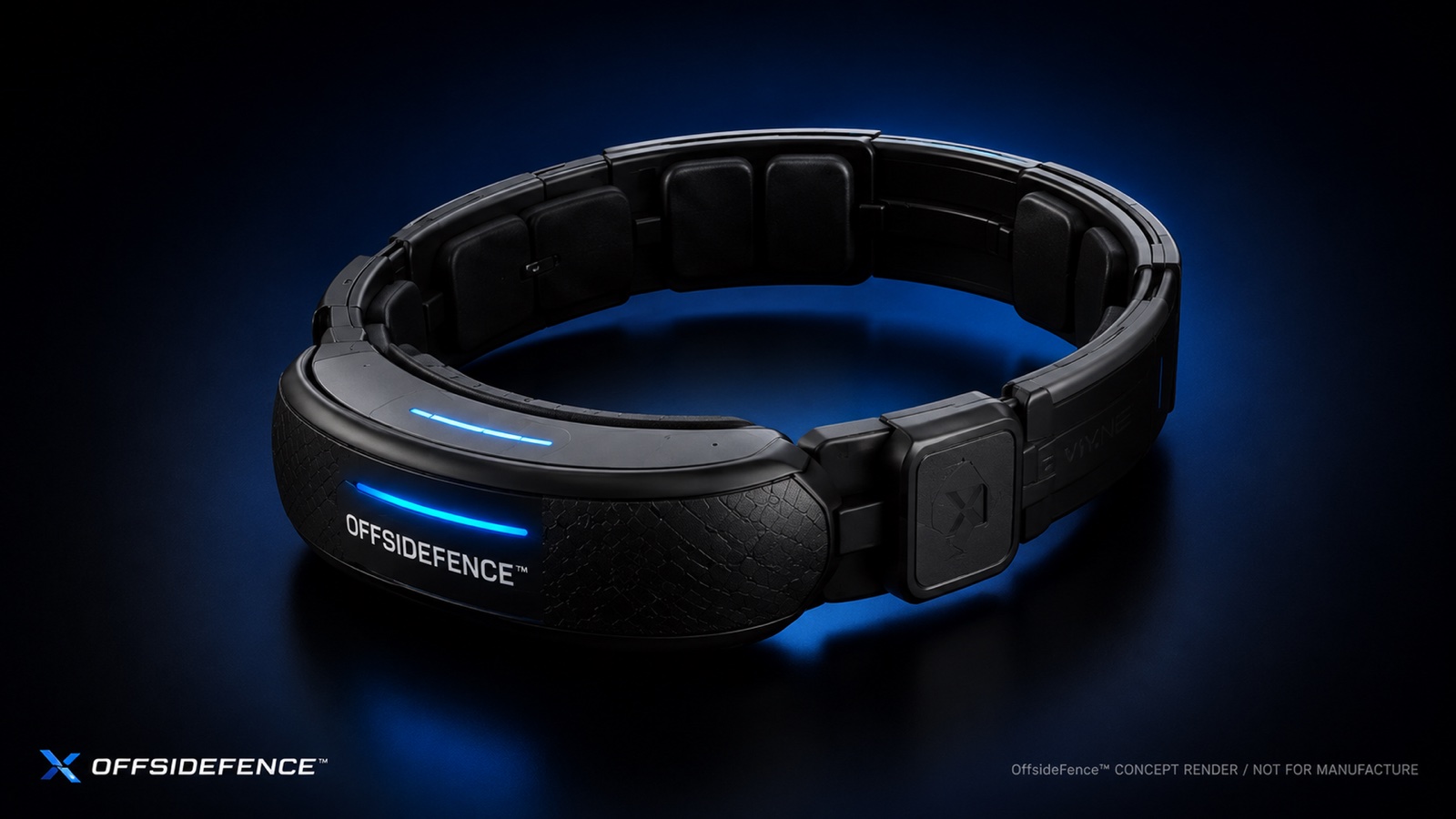
That's when the absurd idea arrived: what if a striker who keeps going offside wore a collar, and when he crossed the line, it gave him a haptic nudge. Colloquially, a zap.
The three-layer structure came later
When the idea first appeared, it was just a joke. A joke finishes and disperses, and nothing stays. What turned it into a project was a structure I worked out later, built in three layers.
The shell layer is the real technology. Roboflow's player detection, pitch keypoints, homography, tactical radar, these are all genuine, open-source, runnable. Anyone who knows the field glances at the tech stack and gives it half their trust before reading further.
The reversal layer is the collar itself. A striker wears one. Cross the line, get a haptic correction. The official term is Haptic Tactical Correction. The colloquial term is a zap. A perfectly serious technical shell wrapped around an utterly absurd product premise, that gap is the entire tension of the piece.
The expression layer is a single line that sets the tone: "The deeper AI goes into soccer, the clearer it becomes. Some problems aren't unsolvable. The player just refuses to remember." That sentence holds the technical seriousness and the product absurdity in place at the same time.
The shell makes you believe. The reversal makes you laugh. The expression makes you think the joke might actually be onto something.
The product has to look real, or the reversal collapses
Once the three layers were clear, the next question was how far to take it.
Our answer: build it to the engineering standard of a real product. The video render, the 3D product shots, the exploded-view diagram, the technical documentation, even the fictional crowdfunding reward tiers, all of it produced to the spec of "we are actually shipping this." The reason is simple. If any single link gives itself away, anyone who knows the field will spot it instantly, and the whole reversal collapses. For the question "is this real?" to actually land, the prerequisite is that it has to genuinely look real.
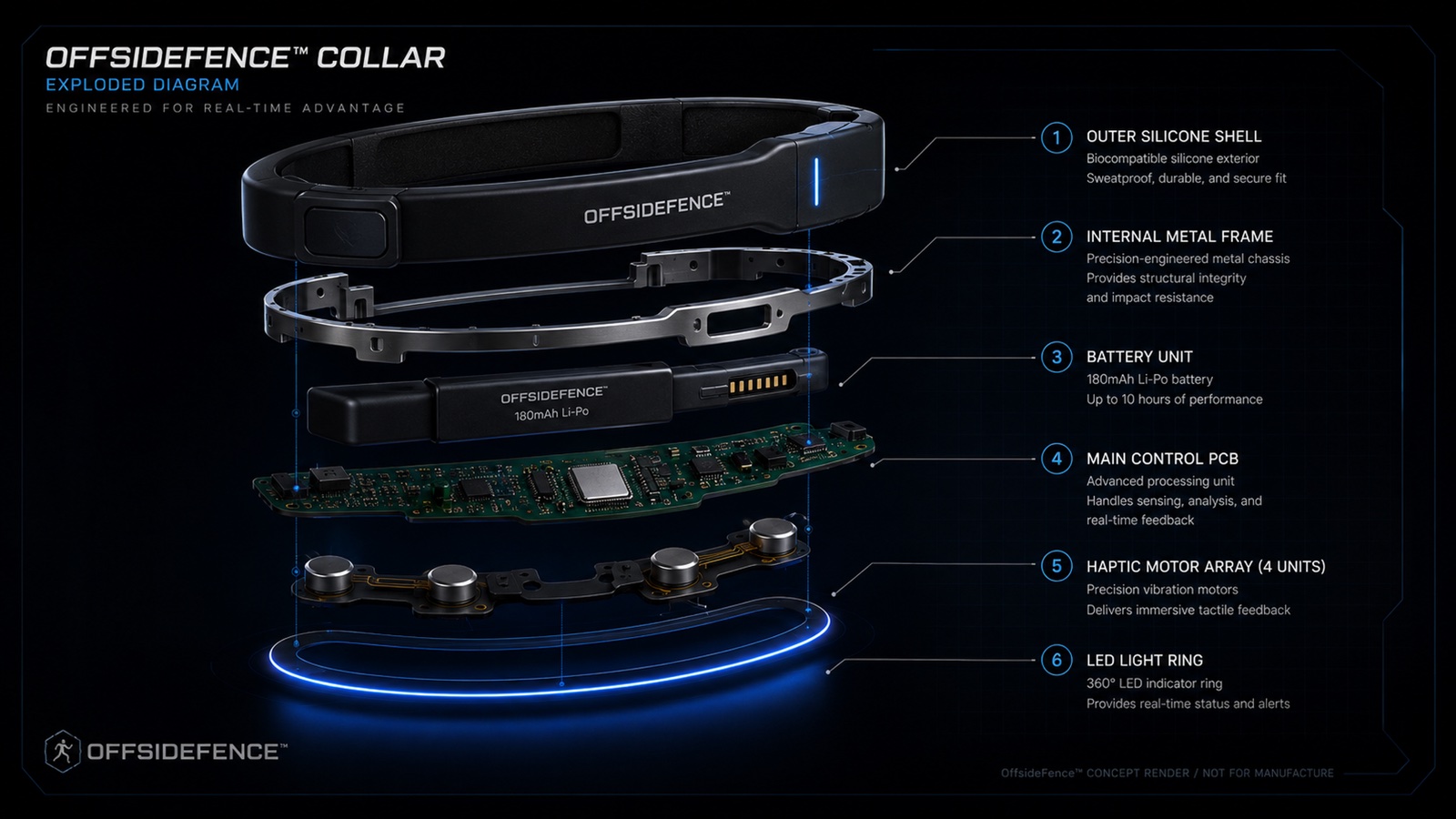
So we designed a complete product persona. Four modes: Training, Match, Darwin (the collar's intensity scales automatically with how often you go offside), and Inzaghi Legacy. That last one needs context for non-soccer readers: Filippo Inzaghi is an Italian striker legendary for two things, scoring goals and going offside constantly, so often that he became a meme. Naming a mode after him is the kind of detail only football fans catch, and catching it makes the whole thing feel more real, not less.
A fictional price sheet: Club License $19,999 per season, $0.03 per offside correction, VAR integration coming soon. Even the slogan a serious tech product deserves: Every run, in the place it belongs.
Each piece looks plausible on its own. Put them together and it starts to resemble a product genuinely gearing up for launch.

The launch film
If the product looks real enough, it should be able to carry a launch film that looks like a real brand campaign. So we made one.
What we set out to test
The project has had one explicit KPI from the start: make the people who should know better, the top 1% of engineers and sports-tech professionals, see it and have a genuine first reaction of "wait, is this real?"
Note who that targets. A casual viewer being fooled doesn't count. They have no way to judge whether the technology is real. Only someone who actually understands computer vision, who actually knows sports tech, someone who reads the tech stack and studies the product shots and the exploded view and still feels that one-second flicker of doubt, only that counts. That's the single metric the whole project cares about.
With that metric in mind, we designed the distribution around it too. We didn't bet everything on a single influencer's repost. Single-point dependency means one broken link takes down the whole chain. Instead, four parallel paths: self-published first (the fully controllable baseline), community seeding on Reddit and Hacker News where the content has to earn discussion on its own merits, KOL outreach as an amplifier rather than a starter, and derivative-work enablement by open-sourcing the asset pack.
The core judgment: self-published is the floor, depending on no one. KOLs double the upside when they hit and leave the baseline untouched when they don't. Those two things must not be confused.
Why we treat this as a research specimen
Underneath it all, the project demonstrates one thing: in the age of AI, how a single person, using AI as leverage, can turn a single thought into a complete body of work.
Concept, visuals, product spec, landing page, open-source repo, crowdfunding page, distribution assets. These used to require a team and months. Now one person plus AI can run the entire set. The output is not necessarily a good product, but the process itself is a specimen of how creation actually happens in the AI era.
We built this never-to-ship product seriously, to demonstrate, in an extreme, absurd, but entirely real and executable way, just how far one person plus AI can go.
That is exactly what the Institute of Artificial Absurdity collects. Not necessarily good things, but things with a process behind them.
OffsideFence will never ship. But every image, every technical document, every product mode was built seriously. The seriousness itself is the entire content of this project.
Not a real product, but content built to the engineering standard of a real one.
It should look real enough that, if you took it seriously, you could actually build it.