
For the past year or two, I used Notion to take notes. I saved old project materials, retrospectives, even prompts. After OpenClaw took off in February and March this year, I handed more of my note-taking and knowledge-base management over to AI agents and moved everything to Obsidian.
The reasons were practical: the notes are local Markdown files, which makes them easy for AI to manage, and the app itself is free.
Then there's the anxiety about leaving all that context in the cloud. These notes and conversations are long-term personal assets. I can't accept leaving them entirely in the hands of a single platform.
For quite a while after the move, I kept thinking about how to collect more useful material and extract more from it. I even dug up years of conversations with ChatGPT about projects we'd worked on, hoping to find something worth keeping.
But when it comes to methods, much of this stuff depreciates fast. Things that seemed worth preserving at the time don't seem all that valuable when I look at them today.
I no longer make a point of stockpiling notes. Some of the organizing had become work I was doing just for the sake of doing it.
Look at my Obsidian graph. Densely packed nodes, connections everywhere. Quite an achievement.
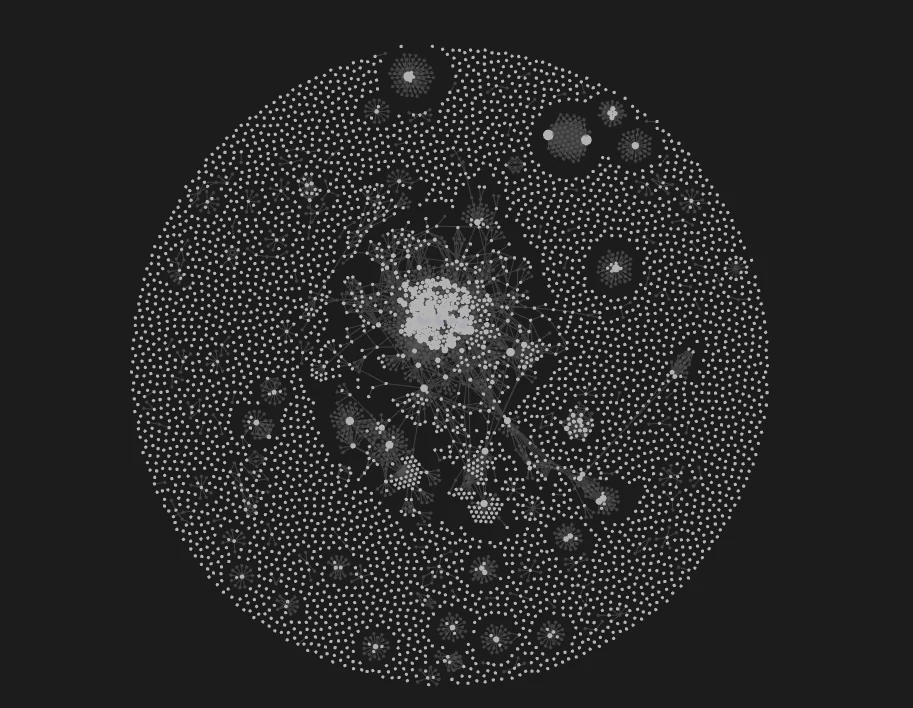
Honestly, though, it hasn't done a damn thing for me.
For much of this year, plenty of Chinese AI content creators have been pitching the personal knowledge base as a second brain. After using one myself, I'm more interested in whether I actually put any of it to use.
See an AI trick, forward it to your agent, have it implement it. Find an article or listen to a podcast, send it to AI to summarize and file away. Read the summary, save the file. Done.
I do this too. Recently, I listened to a podcast that ran four or five hours. Having AI pull out the main points saved me some effort.
After that, I kept asking questions: How did the speaker reach that conclusion? Where does it clash with my own experience? Can I actually use it in the project I'm working on?
Skip those steps, and information processed by AI can easily leave you feeling you've mastered it. I think of this as a kind of cognitive outsourcing.
It's much like saving a pile of videos and posts you never look at again. Saving them makes me feel I have the material. An AI summary can also make me feel I understand it.
Even a complete knowledge base can't apply things, make mistakes, and correct course on my behalf. Learning how to get to grips with a field and how to judge the answers I receive takes practice of my own.
I've set up a decision gate for myself: What can I simply let AI remember, and what's worth spending my own effort to learn?
Material I need for a one-off reference can wait until I need to look it up. If I'm going to rely on something repeatedly to make decisions, I need to keep digging.

So I'm more interested in bringing knowledge back into use, in the moment, than in accumulating more of it.
Having drinks with friends is a good setting for this. You can unpack an idea you've developed and let other people push against it. Everyone brings different context. The same thing can look different to each of us, which gives us a chance to correct and revise our thinking.
Writing it down and explaining it, as I'm doing here, is another way to work through it again. Then I can try it in everyday life and work, and see whether it actually does anything.
In the first half of this year, I took on work in a field completely outside my own. I threw myself into it: reading, researching, going back and forth with AI. Halfway through, I was feeling rather pleased with myself. I thought I'd really figured the field out.
Then I went through several rounds of interviews with AI. I asked it to keep questioning me and find the misconceptions and weak spots in my understanding.
At first, I could talk through everything fluently. But when it asked why a particular plan would work, or whether it would still hold up under different conditions, I started running out of answers.
There were questions I hadn't even realized I'd never considered. Only when we got there did I see the gap.
There's a long way between being able to discuss a plan and being able to test it. I thought I understood. I'd only reached the point where I could talk about it.
Long-term context still has value. It's a personal asset worth building. But I don't want AI to keep agreeing with my past judgments just because it knows me better.
The views I've saved need to remain open to challenge, revision, and being discarded.