A few days ago, I came across Jev AI, a model from TypeSafe AI. It is the company's first public System One model.
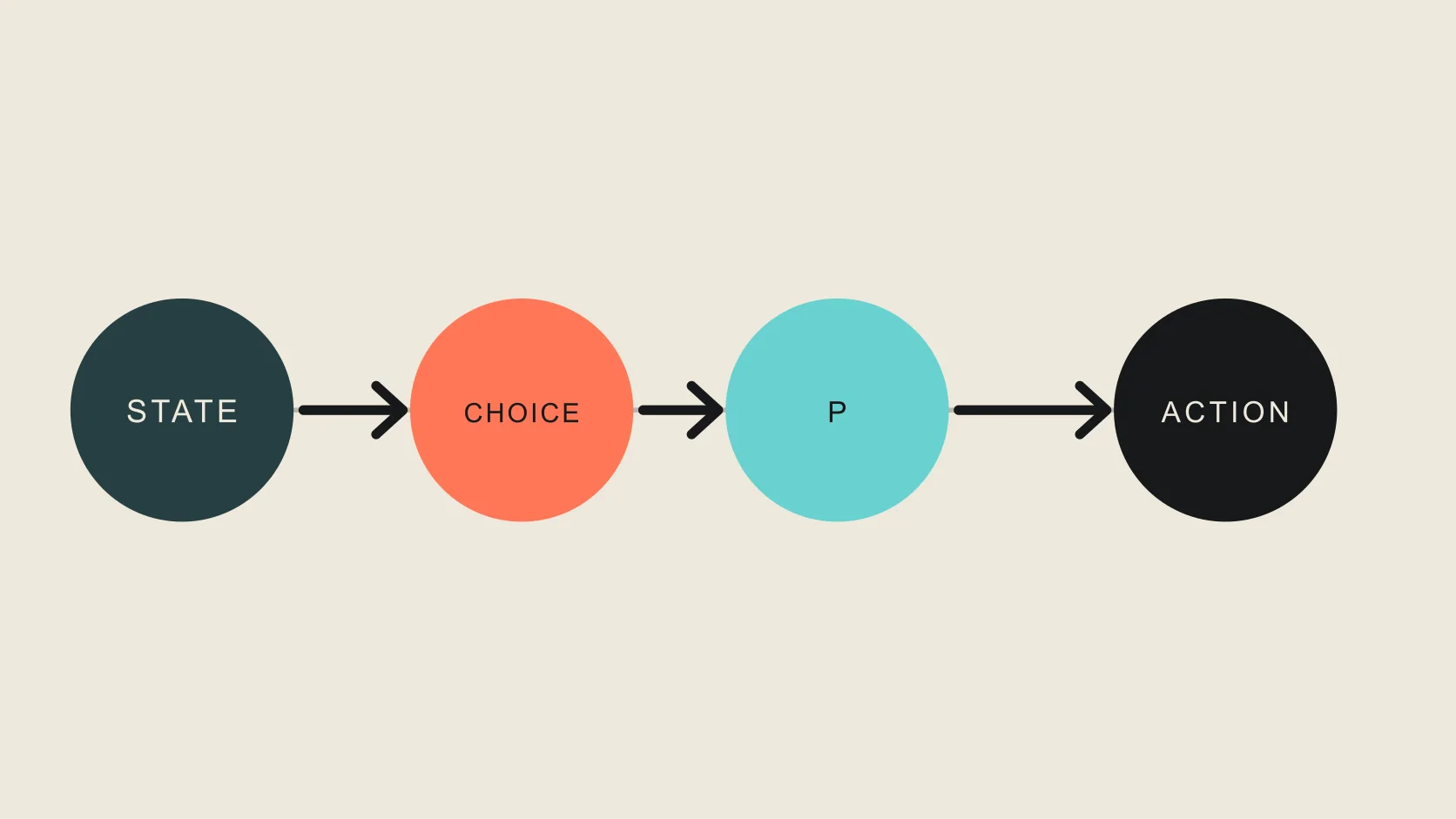
The model has an unusual shape. It does not put conversation, content generation, or a long explanation for a person at the center of its interface. TypeSafe describes Jev as an AI decision model for structured decisions inside software: send a state and typed questions, then receive a Choice, a Score, or a value between 0 and 1 that code can use directly.
My first reaction was simple: plenty of AI systems can make decisions. Why did this one become such a talking point?
I started looking at its latency, its training goal, the question of correctness, and the kind of application it might fit.
What is Jev AI built to do?
TypeSafe reports an end-to-end range of 70 to 500 milliseconds and describes parallel sampling, structured outputs, and a new model architecture as parts of the same automation stack.
I could not remember the name of the R method at first. It is RLCD, or Reinforcement Learning for Calibrated Decisions. TypeSafe describes it as training a model to return typed decisions with calibrated probabilities, so software can respond differently to confident and uncertain results.
That raises the question that fast decision systems cannot avoid: why should software trust a quick answer?
TypeSafe explains calibration as a property of a group of predictions. If many predictions receive a probability of 0.8, their long-run outcome should be close to 80 percent correct. Choice and Score answers include probability distributions and confidence. Noul returns a value between 0 and 1. The application still chooses its thresholds and carries the risk.
I started thinking about human intuition
Picture yourself walking beside a road. A car is coming at you fast. You do not stop to calculate its distance, speed, and arrival time. Your first reaction is physical: this is dangerous, move now.
That is the kind of intuition I had in mind.
I thought about playing football too. After seeing many similar situations, replaying the options, and training a specific response, a player can act faster when the ball arrives. The action looks automatic. It carries a large number of examples and repetitions behind it.
TypeSafe borrowed the System One name from the fast, intuitive System 1 in Thinking, Fast and Slow. The name points to the kind of judgment Jev is built to perform.
What happens inside AI agents when nobody is watching?
This is where the model led me to a larger question.
Language models are usually designed around a human-facing exchange. A model writes text, a person reads it, and the system decides what to do next. Agent systems contain many intermediate steps that no person needs to see: routing, scoring, state updates, action selection, and risk checks.
The familiar loop looks like this: State → Judgment → Human-readable text → Program parsing → Action.
Another loop could look like this: State → Choice / Score / Probability → Action.
I am talking about the handoff format. Some machine-to-machine handoffs can skip natural-language generation for a person.
That could make an inner loop faster. It could also remove one translation step where meaning might be lost. A real comparison would have to measure the difference on the same task.
Could Jev AI power an AI game director?
Two days ago, I was imagining an AI game director for live game broadcasting.
I first designed it from the human side. To direct a game, the system would need to see the screen. It might use multimodal recognition or sampled frames, understand what was happening, then tell the production system which player should receive the camera.
Then I realized that a game is already a digital system. The engine knows player positions, health, equipment, economy, shots, hits, kills, and other events. With a stable interface to that state, an AI could judge who is worth showing, where a fight is likely to start, and whether the current camera still carries information.
The idea connected with Jev immediately. Jev could handle narrow judgments in the machine's inner loop. Code could combine those judgments into a camera policy and an action.
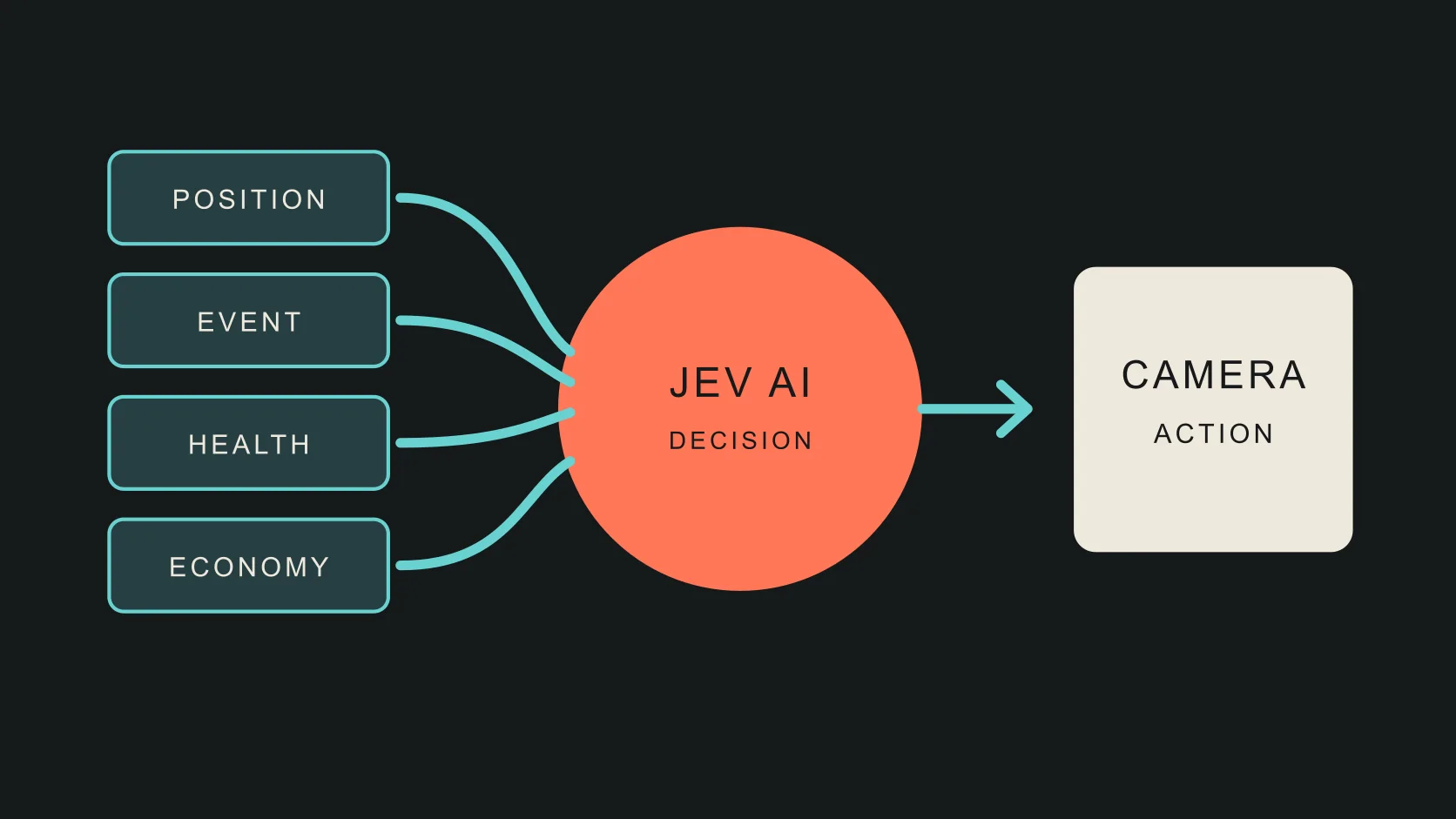
I would start with a few narrow questions: which player deserves the camera, where a fight is likely to start, and whether the current shot still carries information.
The same AI decision problem appears in FlowGrid
FLG is the FlowGrid project I am building. Its decision records let AI agents maintain a project's state, judgments, and changes, while I return to them when I need a retrospective.
When I started using it, I imagined that I would read the decision log over time. AI would record the decisions as the project moved forward, and I would come back later to understand the turning points.
After several months, my use looked different. I rarely opened it on my own. AI did more of the reading and maintenance. I wanted a retrospective at specific moments: halfway through a project, or near the end, when I wanted to know how the project had grown and which information had changed its direction.
That suggests a design hypothesis. Daily work may need a machine state. A human log, summary, or retrospective may be a view rendered from that state. The state would need to preserve the current judgment, its basis, the changes, and unresolved questions, with a path back to the source.
What did the Jev AI and FlowGrid test show?
After the first result, we split the problem into smaller judgments. We took 12 redacted FLG decisions and constructed 48 events. Each decision contributed one supporting, challenging, unrelated, and insufficient-context event. Each event was then evaluated with four independent Noul questions: does it challenge the decision, agree with it, have no relation to it, and provide enough context for a formal judgment?
We first compared the composition on eight events. The single combined relation judgment got 4/8. Once relation signals were separated from context sufficiency, the relation result was 8/8. At 48 events, relation judgments were 48/48 and action mapping was also 48/48. Challenge cases went to owner review, consistent evidence stayed a candidate, unrelated cases stopped propagating, and insufficient cases stayed candidates.
That split gave me a concrete design rule. Low context sufficiency can block formal promotion. It should not erase a high-risk challenge signal. Jev handles semantic judgments. FLG handles relation propagation, state writes, and owner review. Keeping those layers separate made the behavior easier to inspect.
The test using redacted FLG decision excerpts ran in four batches. It took 6.883 seconds in total, with 43,897 input tokens and 5,056 output tokens. A separate fully synthetic Choice control also scored 48/48. It only checked the Choice primitive and contained no private FLG material. The timing includes remote network and batching, so it cannot be compared directly with local FLG relation propagation.
This was a diagnostic evaluation. Codex constructed the 48 events and expected labels from the decision text, with no independent human ground truth. The formal FLG ledger was unchanged, and the isolated status, context, and impact checks passed. The next step is a double-blind human-labeled set of historical evidence, with per-class misses and calibration measured.
For me, Jev's most useful contribution is a practical question: can software exchange state and judgment directly, while language remains available for questions, explanations, corrections, and authorization?
The next step I want is small. Let an AI take over a narrow slice of the broadcasting project from the current state. Check what it carries forward. Then ask it to explain one camera decision and trace each reason back to the source. That result will tell me more than a polished claim about a new paradigm.