When one of Tibo's public reset posts starts circulating on the timeline, users may have a few hours, sometimes longer, to decide whether to use what remains. Once a completion post appears, that round is over.
Most people see two easy-to-miss timeline updates. CodexRadar turns them into a status card: whether a window is active, when it opened, how long the last one lasted, and what happened before. It calls this a speedrun window.

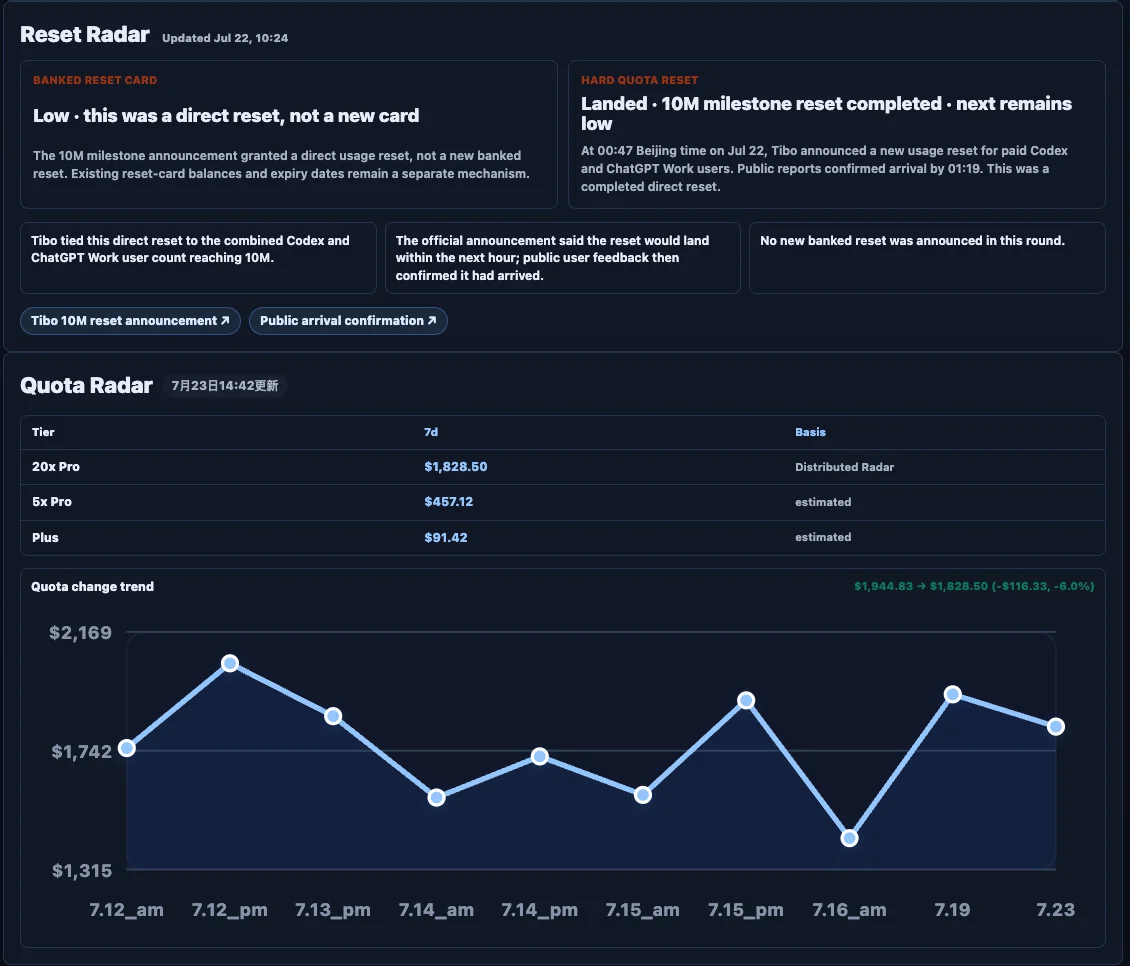
This is an actual product capture collected for the exhibition. Its July 22 and July 23 timestamps are part of the image, not a live reading. It reveals the product's fuller range: the upper reset radar decides whether an event has landed; the quota radar below places seven-day estimates and their changes side by side.
How a post becomes a product
The product does a small number of things.
- It watches public posts from accounts related to Codex.
- It uses terms such as reset, rate limit, and usage limit to find candidates.
- It classifies a post as an announcement, execution, or completion.
- It joins related posts into one event.
- It publishes a human-facing page, `current.json`, and RSS.
CodexRadar's public radar page places reset-card reminders, quota observation, and community testing in one place. Its public introduction describes the page as a view for people, with JSON and RSS for agents, subscriptions, and alerts. That is a tiny piece of event infrastructure: a person reads the first card to decide whether to act; a program reads a status file to decide whether to notify.
It does not choose work for the user. It makes one question more concrete: is the quota I have now worth finding work to spend?

Why this interval changes behavior
The Institute previously published Every Quota Reset, I Regret Not Using More Last Week. That essay looks from the platform side: a fixed subscription price meets a variable workload, so capacity, model launches, user experience, and demand measurement all enter the same supply decision.
Users see another problem.
When quota may reset at any time, unused capacity can create a strange counterfactual loss. People revisit tasks they could have given to an agent yesterday. They save work for a future window, switch models, or calculate whether extra credits are worth buying. Work planning starts to follow a remaining-quota number.
CodexRadar makes that user-side behavior visible. It does not expose an OpenAI operations dashboard. It records when a public announcement appears and when users can treat it as an action signal.
The community theories around resets
People have built several explanations around resets: how rolling windows move, whether removing a short-term limit makes heavy users hit a weekly allowance faster, whether a surprise reset amplifies the feeling that unused quota is wasted, and how subscription economics differ for light and heavy users.
Some of those claims describe observable experiences. Others are inferences. They are useful prompts for inquiry, not substitutes for internal platform data.
We cannot see OpenAI account balances, load, subsidy budgets, or decision processes. A claim about the exact cost of a reset or the precise psychological outcome it was designed to produce needs stronger evidence.

The boundary of a radar product
This kind of product is most useful after a public announcement exists. It watches dispersed information sources continuously, so people are less likely to miss a window.
It cannot know the date of the next reset in advance.
If it later adds a reset-date forecast, the page should show sample size, latest verification, signals used, historical hit rate, and conditions that would invalidate the estimate. A standalone percentage can promise more precision than the evidence holds.
That is why CodexRadar is interesting. It starts with a narrow question that has immediate action value, then grows into a community-maintained station for watching quota, quality, and events. The platform made quota rules. Users made a folk instrument panel for reading them.